Understanding Planetary Relationships & Dignity
2/20/20265 min read
Vedic Astrology Lesson 4: Understanding Planetary Relationships & Dignity (Expanded)
Welcome back to Navgraha Astrology! We've laid the groundwork by understanding the celestial players – the Grahas – and the map of life – the Bhavas. Now, it's time to understand the dynamics between these players and how strong they are on the field. Today, we're going deeper into two fundamental concepts:
Planetary Friendships and Enmities: The social dynamics of the cosmos.
Planetary Dignity: The inherent strength and "performance capability" of each planet.
These concepts are the bedrock of astrological interpretation, helping us discern the quality and intensity of planetary influences in a birth chart.
1. Planetary Friendships and Enmities: The Cosmic Social Network
In Vedic Astrology, planets are not isolated entities. They interact with each other, and their relationships profoundly shape how their energies combine and manifest. Think of it like people in a family or community – some get along famously, others tend to bicker, and some are just indifferent. These relationships are mostly natural (fixed for each planet) but can be modified by other factors (like temporary friendship based on placement).
Understanding the Natural Relationships
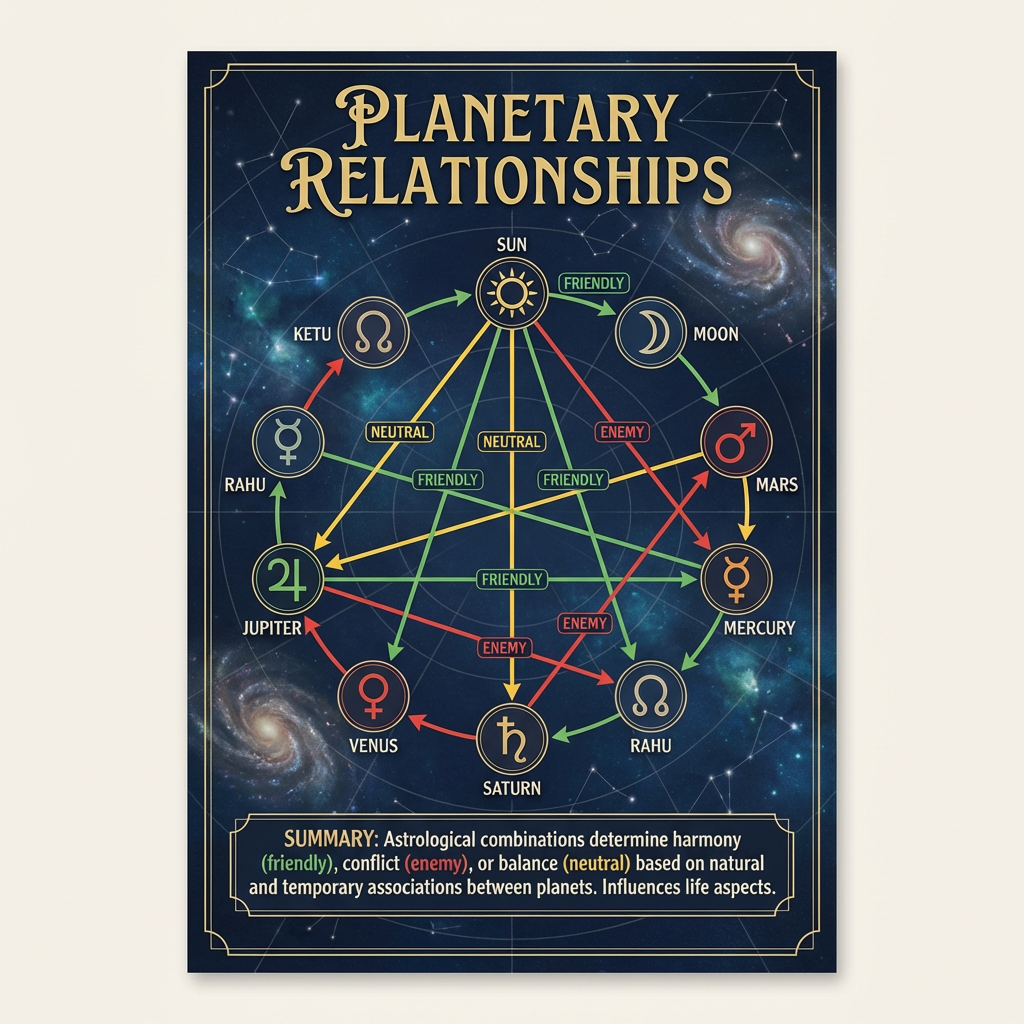
The following is the generally accepted list of natural friends, enemies, and neutrals. This classification is based on several factors, including elemental affinities, historical associations, and mutual supportive qualities.
The Sun (Surya):
Friends: Moon (चंद्र), Mars (मंगल), Jupiter (गुरु). The Sun tends to befriend planets with a similar fiery or expansive nature.
Enemies: Saturn (शनि), Venus (शुक्र). These planets often represent contrasting principles (e.g., structure vs. freedom, materialism vs. spirituality).
Neutral: Mercury (बुध). Mercury, being a very adaptable planet, has a neutral relationship with the Sun.
The Moon (Chandra):
Friends: Sun (सूर्य), Mercury (बुध). The Moon thrives with supportive and communicative energies.
Enemies: Saturn (शनि), Venus (शुक्र). Again, Saturn's discipline and Venus's indulgence can be challenging for the sensitive Moon.
Neutral: Mars (मंगल), Jupiter (गुरु). Mars can be too aggressive, and Jupiter too expansive for the Moon's delicate nature to consider them friends.
Mars (Mangal):
Friends: Sun (सूर्य), Moon (चंद्र), Jupiter (गुरु). Mars likes planets that can match its drive or provide wisdom and stability.
Enemies: Mercury (बुध). Mercury's analytical and sometimes calculative nature can be seen as a dampener on Mars's straightforward action.
Neutral: Saturn (शनि), Venus (शुक्र). Mars's impulsive energy may not harmonize well with Saturn's caution or Venus's aesthetics.
Mercury (Budha):
Friends: Sun (सूर्य), Venus (शुक्र). Mercury is highly adaptable and friendly towards planets that bring clarity (Sun) or artistic/material focus (Venus).
Enemies: Moon (चंद्र). Mercury can sometimes outwit or confuse the sensitive Moon.
Neutral: Mars (मंगल), Jupiter (गुरु), Saturn (शनि). Mercury can work with these planets but doesn't inherently form strong bonds or enmities.
Jupiter (Guru):
Friends: Sun (सूर्य), Moon (चंद्र), Mars (मंगल). The great benefic Jupiter befriends planets representing wisdom, energy, and natural growth.
Enemies: Mercury (बुध), Venus (शुक्र). Jupiter's spiritual and expansive nature can clash with Mercury's analytical logic or Venus's material desires.
Neutral: Saturn (शनि). Saturn's structured approach is neither a friend nor an enemy to Jupiter's expansive wisdom.
Venus (Shukra):
Friends: Mercury (बुध), Saturn (शनि). Venus finds allies in planets related to intellect (Mercury) and structure/discipline (Saturn).
Enemies: Sun (सूर्य), Moon (चंद्र), Jupiter (गुरु). Venus's focus on material pleasures and aesthetics is often at odds with the Sun's ego, the Moon's emotions, and Jupiter's spiritual or expansive guidance.
Neutral: Mars (मंगल). Mars can be a partner, but not a close friend, to Venus.
Saturn (Shani):
Friends: Mercury (बुध), Venus (शुक्र). Saturn appreciates the intellect of Mercury and the material focus of Venus, as these help in structured execution.
Enemies: Sun (सूर्य), Moon (चंद्र), Mars (मंगल), Jupiter (गुरु). Saturn's natural inclination towards discipline, restriction, and delays clashes with the more free-spirited, expansive, or energetic planets.
Neutral: Saturn (itself). Saturn is generally neutral to its own placement.
Significance in Chart Interpretation:
Harmony and Conflict: When friendly planets are in conjunction or aspecting each other, their positive significations are enhanced. For example, a friendly Jupiter and Venus in the 5th house could strongly indicate blessings in creativity, romance, and children. Conversely, enemy planets in challenging configurations can create friction. Mars and Saturn together can bring about slow, difficult, but perhaps powerfully constructed outcomes.
Amplification and Mitigation: A strongly placed friendly planet can help a weaker planet perform better, while an enemy planet might further weaken an already afflicted planet.
Understanding Complexities: This helps us understand why some people achieve success easily, while others face constant struggles, even with seemingly "good" planets in their chart – the relationships between planets play a huge role.
2. Planetary Dignity: The Planet's "State of Being"
Planetary dignity is about a planet's inherent strength and ability to express its natural significations in a chart. It’s not just about where a planet is (which house), but how well it is equipped to handle that position and deliver its results.
Levels of Dignity (From Strongest to Weakest)
Moolatrikona (मूलत्रिकोण):
This is the most preferred sign for any planet. It's where the planet feels most "at home" and its unique qualities shine brightest, especially in its role as a significator of certain life areas.
Example: Jupiter's Moolatrikona sign is Sagittarius (9th sign). When Jupiter is in Sagittarius, it is exceptionally strong and benevolent.
Each planet has one unique Moolatrikona sign.
Own Sign (स्वक्षेत्र - Swakshetra):
When a planet occupies its own sign, it is very strong and capable. It has mastery over its domain and can function with great confidence and effectiveness.
Example: Mars is the ruler of Aries and Scorpio. If Mars is in Aries or Scorpio, it is in its own sign and considered strong.
Note: Sometimes a planet's Moolatrikona sign is also its own sign (e.g., Sun in Leo). In such cases, Moolatrikona is considered the primary and highest dignity.
Exaltation (उच्च - Uchcha):
A planet in its sign of exaltation is considered very powerful. It is said to be "uplifted" and can deliver its positive potentials with great force and enthusiasm. However, it might be too enthusiastic or lack the grounding of an "own sign" placement, sometimes leading to unbalanced results if not supported.
Key Exaltations:
Sun: Aries (मेष)
Moon: Taurus (वृषभ)
Mars: Capricorn (मकर)
Mercury: Virgo (कन्या)
Jupiter: Cancer (कर्क)
Venus: Pisces (मीन)
Saturn: Libra (तुला)
Friendly Sign (मित्रक्षेत्र - Mitrakṣetra):
A planet in the sign of a natural friend is also considered strong, though perhaps not as potent as in its Moolatrikona, Own Sign, or Exaltation. It benefits from the supportive environment.
Neutral Sign (समक्षेत्र - Samakṣetra):
When a planet is in a sign ruled by a neutral planet, its strength is moderate. It functions without significant enhancement or hindrance.
Enemy Sign (शत्रुक्षेत्र - Shatrukshetra):
A planet in the sign of its natural enemy is weakened. It struggles to express its natural significations effectively, often leading to delays, obstacles, or misdirected energy.
Debilitation (नीच - Neecha):
This is the weakest state for a planet. It is considered "fallen" or "depressed." Its ability to deliver positive results is severely diminished, and it may manifest its negative potentials more strongly or in a distorted way.
Key Debilitations (Opposite of Exaltations):
Sun: Libra (तुला)
Moon: Scorpio (वृश्चिक)
Mars: Cancer (कर्क)
Mercury: Pisces (मीन)
Jupiter: Capricorn (मकर)
Venus: Virgo (कन्या)
Saturn: Aries (मेष)
The Crucial Concept of "Neecha Bhanga" (Cancellation of Debilitation)
This is a vital exception! A debilitated planet isn't automatically doomed to fail. If certain conditions are met within the chart, the debilitation can be canceled, or its ill effects significantly reduced. Some common ways this happens:
The planet that rules the sign of debilitation is well-placed.
The planet that exalts in the sign of debilitation is well-placed.
The planet is in conjunction with its lord or the lord of its exaltation sign.
The debilitated planet is in a Kendra house from the Ascendant or Moon.
A "Neecha Bhanga" planet can often prove to be very powerful and successful, overcoming initial struggles.
Integrated Astrological Interpretation
When reading a chart, we combine all these elements:
Core Strength: A planet's dignity (Moolatrikona, Own Sign, Exaltation vs. Debilitation) is its fundamental capacity.
Support System: Its relationships (friends, enemies) and its placement in the sign of a friend or enemy modify this capacity.
Area of Operation: The house it occupies shows where it applies its strength.
Overall Condition: Aspects and conjunctions from other planets further refine its expression.
Example: Imagine Jupiter (wisdom, expansion, luck).
Best: Jupiter in its Moolatrikona (Sagittarius) or Own Sign (Sagittarius, Pisces) or Exalted (Cancer). It will powerfully bestow blessings in its houses and significations.
Good: Jupiter in a friendly sign (e.g., Mars's sign Aries or Scorpio). Still strong, but with Mars's energy.
Challenging: Jupiter in its enemy sign (Mercury's Virgo, Venus's Pisces). Its wisdom might be clouded by analytical concerns or material desires.
Weakest: Jupiter in its debilitation sign (Capricorn). It will struggle to deliver its full wisdom, luck, or expansion, often appearing inefficient, overly cautious, or dogmatic. Unless there's a strong Neecha Bhanga.
Contact
Reach out for bookings or questions
Phone
Contact@Navgrahaastrology.com
+918264516399
© 2026. All rights reserved.