
Vimshottari Dasha
2/27/20266 min read
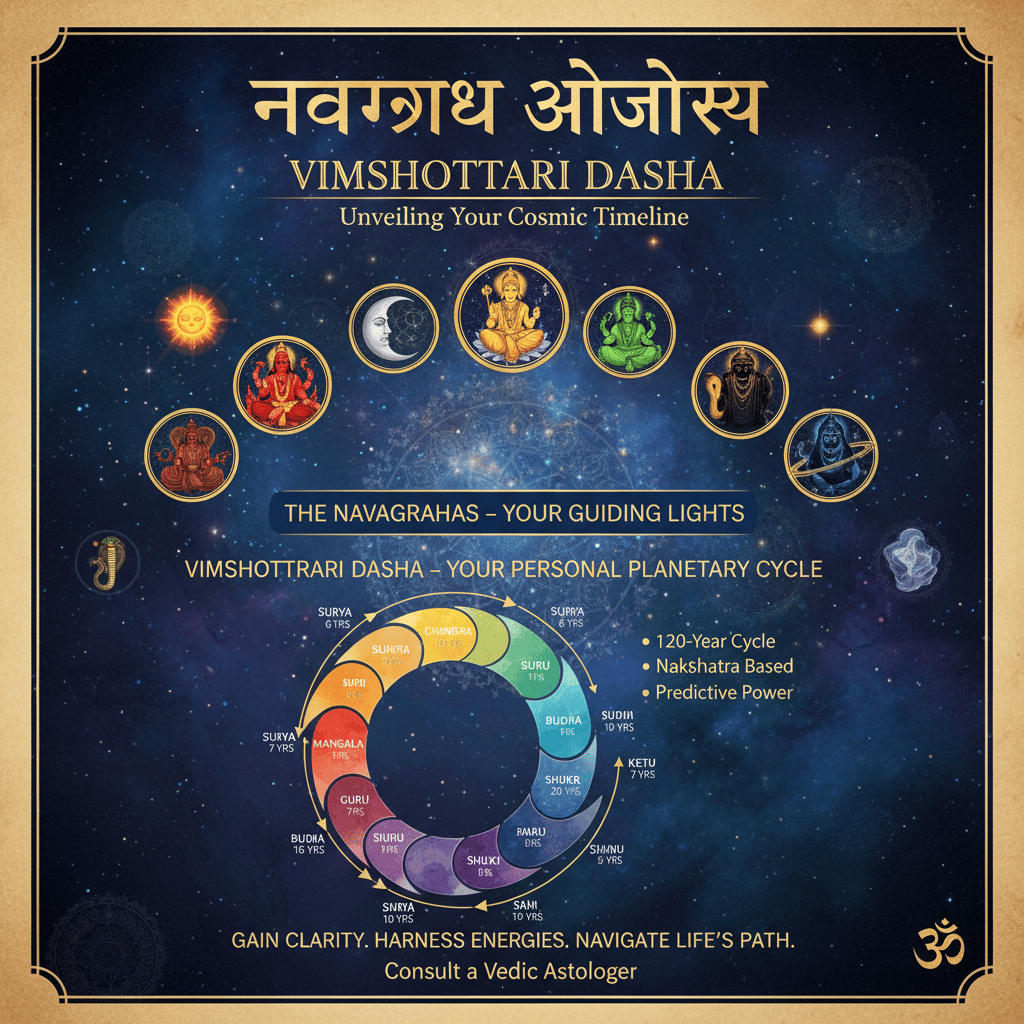
Vedic Astrology Lesson 5: Vimshottari Dasha (विम्शोत्तरी दशा) - The Timeline of Karma
Prerequisites: Rashis, Bhavas, Grahas, Graha Mitrata, Graha Drishti Author: Ajay Navgraha | www.Navgrahaastrology.com
Learning Objectives
Master the authentic Vimshottari Dasha system—the cornerstone of Vedic astrological prediction. By the end of this lesson, you will understand:
Dasha as a karmic timeline, revealing the unfolding of destiny
The 120-year cycle and its profound connection to human life
How to determine your Natal Dasha based on the Moon's Nakshatra
The layered timing of Mahadasha, Antardasha, and Pratyantar Dasha
How Dasha activation interacts with planetary Drishti and chart promises
The principles for predicting life events through Dasha-Bhukti combinations
The importance of remedies during challenging planetary periods[1][2][5]
Philosophical Foundation: What is Dasha?
Dasha (दशा) in Sanskrit translates to "state" or "condition." In Vedic Astrology, it signifies far more than just a planet's turn to influence your life.
The Vedic Understanding of Dasha:
Karmic Unfolding: Each planetary Dasha period is understood as the cosmic mechanism that activates the specific karmic seeds sown in your past. It's when the fruits of those actions, both positive and challenging, are scheduled to ripen in this lifetime.[1][3]
Timing of Potentials: Your birth chart (Janam Kundali) holds all the potentials and promises of your life. The Dasha system reveals the precise when – the sequence in which these potentials will manifest.
Divine Justice and Lifespan: The Vimshottari system spans 120 years, considered the ideal human lifespan in Vedic tradition. This cycle ensures that each planet, reflecting different aspects of life and karma, gets its predetermined, proportional time to operate, reflecting a cosmic law of balance and justice.[3][5]
The Soul's Journey: Dashas are intimately connected to your Prarabdha Karma – the portion of your past karma that is destined to be experienced in the current life. They map out the soul's progression through various life lessons and experiences.
The Sacred Truth:
Imagine your birth chart as a detailed map of a vast territory. The Dasha system is like your travel itinerary, guiding you through specific regions of that map at different times. Without understanding the Dasha, your chart remains a static picture; with it, you see the dynamic journey of your life unfolding.
Vedic Wisdom: "A planet might indicate immense wealth in your birth chart, but it is only during that planet's Mahadasha and relevant Antardasha that such wealth can manifest." This highlights the critical role of Dashas in predictive astrology.[1][2]
The Vimshottari System: A 120-Year Karmic Blueprint
The Vimshottari Dasha system, often called the "120-year Dasha," is the most revered and widely applied system in Vedic Astrology for predictive purposes.
The Distribution of Time:
The 120-year cycle is divided among the nine classical Grahas (planets), with each receiving a specific number of years, reflecting their planetary nature and cosmic influence:
Ketu: 7 years
Venus: 20 years
Sun: 6 years
Moon: 10 years
Mars: 7 years
Rahu: 18 years
Jupiter: 16 years
Saturn: 19 years
Mercury: 17 years
Total: 120 years
Vedic Logic Behind Durations:[1][3][5]
The lengths are not arbitrary. They are designed to align with the perceived speed and influence of each planet in the sky, and their corresponding karmic weight:
Slower Moving Planets (Saturn, Rahu, Jupiter) are allotted longer periods, signifying their profound and often long-lasting impact on life themes.
Faster Moving Planets (Sun, Mars, Ketu) have shorter periods, suggesting that their results can be quicker or more intensely felt in shorter bursts.
Moderate Speed Planets (Moon, Mercury) fall in between.
Venus, the great benefic, receives the longest period (20 years), underscoring its significant role in bestowing worldly pleasures, relationships, and material comforts.
The Lunar Mansion (Nakshatra) Connection: Your Natal Dasha
Your starting point in the Vimshottari Dasha cycle is determined by the Nakshatra (lunar mansion) occupied by your Moon at the time of your birth. This is a crucial Vedic principle, as the Moon represents your mind, emotions, and inner nature.
The 27 Nakshatras and Their Ruling Grahas:
The 27 Nakshatras are sequentially linked to the nine Grahas. Each Graha rules a specific set of Nakshatras, and the cycle repeats three times to cover the 120-year span (27 Nakshatras ÷ 9 Grahas = 3 cycles per Graha).
The sequence of ruling Grahas for Nakshatras is: Ketu, Venus, Sun, Moon, Mars, Rahu, Jupiter, Saturn, Mercury.
Determining Your Starting Dasha:
Locate your Moon's Position: Find the exact degree and minute of your Moon in your birth chart.
Identify the Nakshatra: Determine which of the 27 Nakshatras your Moon falls into.
Find the Ruling Graha: Match the Nakshatra to its ruling Graha from the sequence. This Graha begins your Vimshottari Dasha sequence.
Calculate the Balance: Determine how far into that Nakshatra your Moon was placed at birth. This precise astrological calculation will tell you how many years and months of that ruling Graha's Dasha you experienced from birth, and therefore, which Dasha starts after that.
Example Calculation (Simplified):
Suppose your birth chart shows your Moon at 15° Taurus.
The Nakshatra Rohini spans from 10° to 23°20' Taurus. Your Moon falls within Rohini.
Rohini is ruled by the Moon. Therefore, your Vimshottari Dasha sequence begins with the Moon Dasha.
If your Moon was placed exactly halfway through Rohini, you would have experienced half of the Moon's 10-year Dasha (5 years) from birth. Your sequence would then start with the next Graha in line (Mars, ruling Mrigashirsha Nakshatra, which follows Rohini).
Vedic Precision: The exact calculation of the balance of the Nakshatra is performed using astronomical tables or software, ensuring accuracy in determining the start of the Dasha sequence.
The Nested Layers of Dasha Timing
To achieve predictive accuracy, Vedic Astrology utilizes a layered Dasha system:
1. Mahadasha (महादशा) — The Major Period
Duration: 7 to 20 years, corresponding to the Graha's total Dasha years.
Influence: This is the primary theme or overarching energy that colors the entire period of your life governed by that Graha. It sets the stage for the major life experiences and lessons you will encounter.
Strength: The most significant influence in the Dasha sequence.
Example: If you are in Jupiter's Mahadasha for 16 years, the energy of Jupiter – wisdom, expansion, good fortune – will be the dominant theme of your life during that period.
2. Antardasha (अंतर्दशा) — The Sub-Period (also known as Bhukti)
Duration: This is a proportional slice of the Mahadasha, calculated based on the Antardasha planet's total Dasha years relative to the 120-year cycle.
Influence: Within the broad theme of the Mahadasha, the Antardasha planet brings more specific results and refines the experiences. It acts as a sub-plot or a finer modulation of the main theme.
Strength: A significant secondary influence, much more specific than the Mahadasha.
Example: Within Jupiter's 16-year Mahadasha, the Antardasha of Saturn (19 years) would last approximately (16 years * 19 years) / 120 years ≈ 2.5 years. During these 2.5 years, the expansive blessings of Jupiter would be tempered or tested by the disciplined, karmic nature of Saturn.
3. Pratyantar Dasha (प्रत्यंतर्दशा) — The Sub-Sub-Period
Duration: This is an even finer division, calculated proportionally within the Antardasha. These periods can last from several months down to a few weeks.
Influence: This layer provides the immediate triggers for events. It often pinpoints the exact time frame when specific outcomes manifest, bringing clarity to the month-to-month or week-to-week unfolding of events.
Strength: The most specific influence, often revealing the day-to-day or week-to-week experiences.
Example: Within Saturn's 2.5-year Antardasha, the Pratyantar Dasha of the Sun (6 years) would last approximately (2.5 years * 6 years) / 120 years ≈ 0.125 years, which is about 45 days. This 45-day period would highlight the interplay of Saturn's discipline and the Sun's authority/ego within the broader Jupiter Mahadasha theme.
The Hierarchy of Influence:
Mahadasha sets the stage, Antardasha refines the plot, and Pratyantar Dasha reveals the specific scenes and actions. Major life events often occur when the planets ruling the Mahadasha, Antardasha, and Pratyantar Dasha have supportive connections to the relevant houses and planets in the birth chart.
💡 Interpreting Dashas: The Synthesis of Vedic Knowledge
The true power of Dasha analysis lies in integrating this timing system with the knowledge gained from previous lessons:
1. The Graha's Intrinsic Nature (Svabhava):
Benefics (Jupiter, Venus, Moon, Mercury – when well-placed) tend to bring positive results, expansion, blessings, and protection during their Dashas.
Malefics (Saturn, Mars, Sun, Rahu, Ketu) often bring challenges, tests, delays, or transformative experiences. However, they can also bring strength and results if they are well-placed or rule beneficial houses.
2. The Graha's Strength in the Natal Chart:
A planet that is strong (exalted, in its own sign, conjunct benefics, well-aspected) will deliver powerful results, whether positive or challenging, during its Dasha.
A weak planet (debilitated, in enemy sign, afflicted) may struggle to deliver significant results, or its Dasha might manifest difficulties or require considerable effort.
3. Lordship and Drishti (Integration with Previous Lessons):
Lordship: The houses a planet rules become activated during its Dasha. If it rules difficult houses (e.g., 6th, 8th, 12th) and is malefic, its Dasha might bring challenges related to those areas. If it rules beneficial houses (e.g., 1st, 5th, 9th, 10th) and is benefic, its Dasha brings blessings.
Drishti (Aspects): The houses a planet aspects are also influenced. During its Dasha, a planet's aspects gain prominence, activating those areas of life with its characteristic energy. For example, Saturn's aspect on the 7th house during its Dasha will strongly influence marriage and partnerships.
Vedic References
[1] Brihat Parashara Hora Shastra (BPHS) — The foundational text on divisional charts including Navamsha. [2] Jataka Bharatiyam by Sripati — Detailed treatment of Navamsha calculations and interpretations. [3] Saravali by Kalyana Varma — Explanations of Navamsha effects on various life areas. [4] Phaladeepika by Mantreswara — Comprehensive guide to reading Navamsha. [5] Hora Ratnam — Reference for Navamsha significance and methodology.
"The Rasi chart shows what the world sees; the Navamsha shows what God knows. Study both, and you will understand the complete mystery of your destiny." — Ancient Vedic Wisdom
Author: Ajay Navgraha Website: www.Navgrahaastrology.com Bringing authentic Vedic wisdom to the modern seeker
Contact
Reach out for bookings or questions
Phone
Contact@Navgrahaastrology.com
+918264516399
© 2026. All rights reserved.